October 17, 2026
Paragraph Generator AI: How to Craft Compelling, Contextual Copy in Seconds
Every writer, marketer, and student has stared at a blinking cursor on an empty screen, paralyzed by the sheer friction of drafting the opening paragraph. Writer's block is rarely a lack of ideas; it is a breakdown in cognitive momentum. Modern generative artificial intelligence has fundamentally altered this dynamic through the emergence of a paragraph generator AI.
Far from replacing human creativity, AI paragraph writers act as intelligent thought partners. They take fragmented bullet points, raw outlines, or rough thesis statements and rapidly synthesize cohesive paragraphs complete with introductory hooks, supportive context, and smooth transitions. Let's examine how AI generation functions, explore prompt engineering principles, and review human-in-the-loop editing rules.
How a Paragraph Generator AI Synthesizes Text
Modern text generation models (such as large language models developed on transformer architectures) process language not as static definitions, but as probabilistic semantic vectors. When you feed a prompt into a paragraph generator AI, the system calculates contextual relationships between your specified subject, tone, and audience.
Instead of regurgitating canned templates, the AI predicts the most logical sequence of words that answers the user's intent while adhering to natural grammatical syntax. The result is a fluid, readable paragraph that serves as a solid foundation for further human refinement.
The 4 Pillars of a Well-Structured Paragraph
Whether written by an artificial intelligence or a veteran journalist, an effective paragraph must fulfill four architectural roles:
- The Topic Hook: A captivating opening sentence that introduces the primary assertion or theme without preamble.
- The Contextual Explanation: Two to three sentences that elaborate on the assertion, defining key parameters or providing essential background.
- The Supporting Evidence: Concrete examples, data points, logical deductions, or real-world analogies that validate the opening claim.
- The Transitional Bridge: A concluding thought that ties the paragraph together and seamlessly guides the reader into the next section.
Prompt Engineering for Superior AI Paragraphs
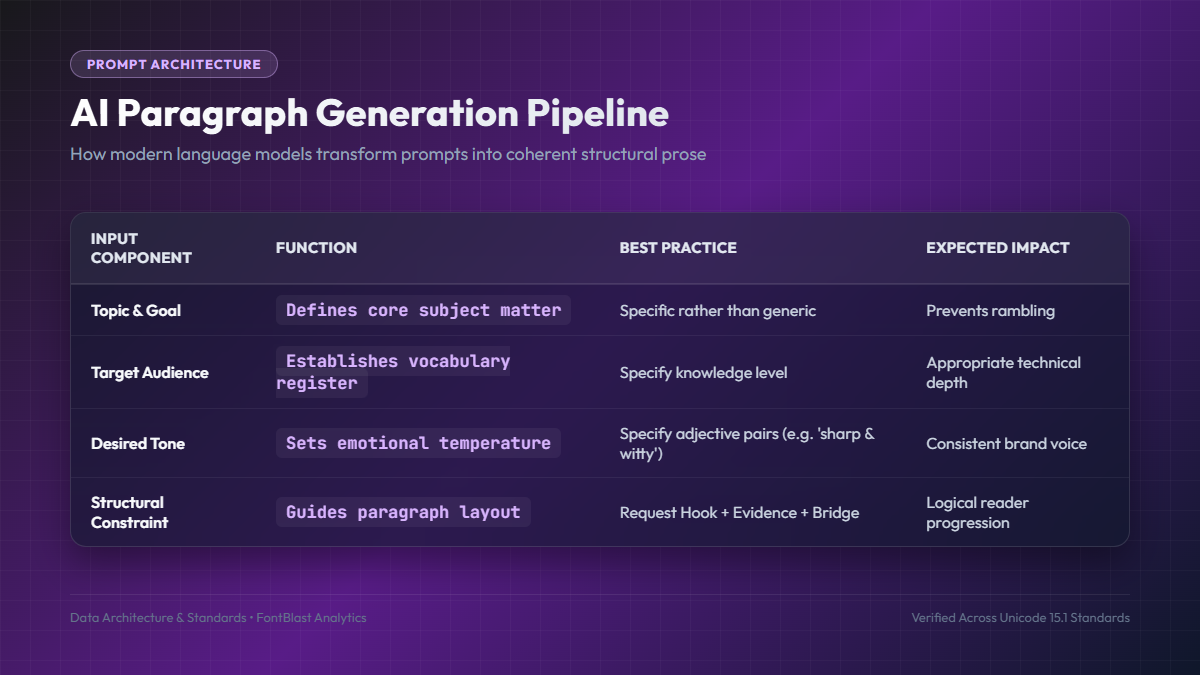
The quality of your output is directly determined by the quality of your input. Avoid vague prompts like "Write a paragraph about fonts." Instead, utilize the multi-constraint prompting technique:
| Prompt Element | Weak Example | High-Performing Example |
|---|---|---|
| Topic Clarity | Web design | Why typography choices influence e-commerce checkout conversion rates |
| Tone Directive | Professional | Authoritative, data-backed, and direct; avoid generic corporate buzzwords |
| Audience Context | Everyone | Senior product managers and UX designers evaluating design system overhauls |
The Human-in-the-Loop Refinement Rule
"Use AI for the initial draft, but rely on human judgment for the final craft. Great writing requires genuine empathy and lived experience."
When working with a paragraph generator AI, treat the generated copy as clay waiting to be sculpted. Always perform these three editorial passes:
- Fact-Checking: AI models can occasionally hallucinate statistics or attribute quotes incorrectly. Always verify hard claims against primary sources.
- Voice Infusion: Add personal anecdotes, brand-specific terminology, and your unique stylistic cadence.
- Length Calibration: Trim unnecessary qualifying words to keep paragraphs under 100 words for optimal mobile reading.
- Typography Matching: Present your generated content beautifully by selecting complementary web typefaces from our Free Fonts Directory and exploring our Social Fonts Generator.
Frequently Asked Questions About AI Paragraph Generators
Can AI write full articles on its own?
While an AI can draft full sections, the highest-performing content results from a collaborative workflow where the writer outlines arguments, uses AI for paragraph synthesis, and conducts thorough human editing.
How do I make AI output sound less robotic?
Specify concrete stylistic constraints in your prompt: request varied sentence lengths, forbid passive voice, and instruct the model to avoid common clichés like "in today's fast-paced digital world."
Empower your daily writing routine by combining AI generation with fine typography from our Text Decorator and Free Fonts Showcase.